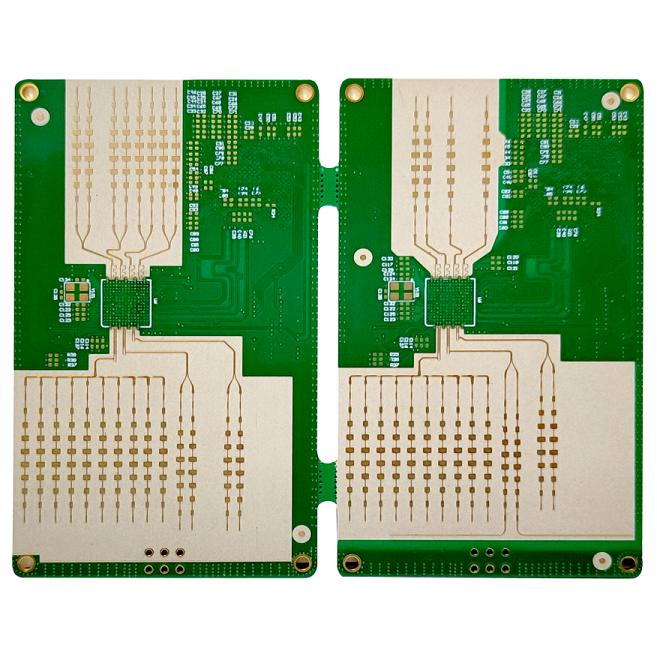
What is a Rogers PCB Board ? | PCB Knowledge
Rogers PCB Board is a high-frequency PCB material model produced by Rogers Company. It is a high-performance, multi-layer composite circuit board. Different from traditional FR-4 PCB materials.Rogers PCB materials do not contain epoxy resin, and high-frequency PCB materials use Rogers ceramic PCBs. Rogers PCB has excellent dielectric constant and temperature stability. The thermal expansion coefficient of Rogers PCB dielectric constant is very consistent with the thermal expansion rate of copper foil, which can be used to improve the shortcomings of PTFE substrate; it is very suitable for high-speed PCB and high-speed PCB design, as well as commercial microwave antenna and RF product applications. Because Rogers PCB has extremely low water absorption, it can be used as an ideal choice for applications in high-humidity environments. It provides customers in the high-frequency PCB industry with the highest quality Rogers PCB information and related resources, fundamentally managing quality PCB quality.

BGABoard Automotive electronics Rogers Substrates
Rogers PCB Board is widely used in high-frequency PCB and high-reliability fields such as microwave communications, 5g, and military radar.
Why Choose Rogers PCB Board?
With the development of 5G technology, more and more devices require high-performance high-frequency PCBs and RF PCBs, which require low signal loss and low electrical noise. Rogers PCB materials are cost-effective and fully meet the required technical requirements.
Rogers PCB (Printed Circuit Board) Applications:
Rogers PCBs have numerous applications across different sectors. It includes the following.
You can use Rogers PCBs as key components in antennas for cellular base stations, live broadcast satellites, communications systems, microwave equipment, 5G modern radios, carrier-grade Wi-Fi, and more.
Automobile industry. Rogers PCBs can be deployed in automated/mechanized test equipment (ATE), automotive radars, sensors, and more.
RF Engineering. You can also deploy Rogers printed circuit boards in power amplifiers, IP infrastructure, RFID tags, and more.
Aeronautical Engineering. Rogers PCBs can also be deployed in ACAS or aircraft collision avoidance systems, backhaul radios, microstrip antennas, and more.
Rogers PCBs are also used in DAS and ADAS (Advanced Driver Assistance Systems) and other useful computer fields.
In the military, Rogers PCBs are used in radio communications systems, jamming systems, and more.

BGABoard Communications Rogers Substrates
As data capacity increases, 4G and 5G wireless communication networks require powerful backhaul links. Such networks require large amounts of data to be sent not only between mobile users and base transceiver stations, but also between different nodes in the network and ultimately to the main switching station for access to the backbone Internet. Wireless backhaul connections are typically via fiber optic cables or microwave radios.
When designing components for these higher frequency microwave radios and wireless backhaul equipment, designers must understand the losses that affect radio signal strength from a materials perspective, specifically dielectric losses and conductor losses. Materials developed for use at frequencies below 40 GHz must be upgraded and optimized to perform appropriately at higher frequencies. Microwave radios in the E-band require ultra-low loss dielectric materials based on PTFE or advanced thermoset technology.
Rogers has optimized its ultra-low-loss circuit material mix, using low-roughness copper foil to minimize conductor losses, allowing for use at higher frequencies. Today, microwave radios from 6 GHz to 80 GHz offer a complete set of backhaul solutions using Rogers' low-loss materials and low-profile copper foils.

BGABoard Microwave Equipment Rogers Substrates
Features of Rogers substrate PCB:
1. Good rigidity, good mechanical and electrical properties, and easy hole metallization;
2. Rogers PCB board thickness accuracy is high;
3. Rogers substrate PCB has good copper sheet adhesion, high heat dissipation capacity, good peel strength, and no delamination or blistering;
4. The processing cost of Rogers PCB is compatible with FR-4 processing technology, but the board cost is high.
5. Rogers substrate PCB is the most stable material in the industry. It has the characteristics of low dielectric loss and low water absorption, and the dielectric constant (DK) changes stably with frequency. It has lower outgassing rates in aerospace applications. It is widely used in high reliability, aerospace and defense applications or harsh environment applications.
Rogers substrate PCB series
3000 series (polytetrafluoroethylene+ceramic/PTFE+ceramic glass fiber, DK=3.0-10.2): RO3003, RO3003G2, RO3035, RO3006, RO3010, RO3203, RO3206, RO3210
4000 series (hydrocarbon + polytetrafluoroethylene, DK=3.38-6.15): RO4350B, RO4003C, RO4835, RO4360G2
(Hydrocarbon + PTFE + ceramic glass fiber, DK=3.3-3.5): RO4533, RO4534, RO4535, RO4725JXR, RO4730JXR, RO4730G3
5000 series (glass fiber + polytetrafluoroethylene, DK=1.96-2.33): RT/tungsten carbide 5880, RT/tungsten carbide 5880LZ, RT/tungsten carbide 5870
6000 series, suitable for electronic circuits and microwave circuits requiring high dielectric constant.
(PTFE + ceramic, DK=2.94-10.2): RT/tungsten carbide 6002, RT/hard material 6202PR
TMM series (hydrocarbon + ceramic, DK=3.27-12.85): TMM3, TMM4, TMM10, TMM10i, TMM13i
Others: Kappa 438
Prepreg: RO4450B, RO4450F
Adhesive film: 2929, 3001, ULTRALAM3908, RO3003, RO3006, RO3010, RT/tungsten carbide 6002
2. Rogers PCB board thickness accuracy is high;
3. Rogers substrate PCB has good copper sheet adhesion, high heat dissipation capacity, good peel strength, and no delamination or blistering;
4. The processing cost of Rogers PCB is compatible with FR-4 processing technology, but the board cost is high.
5. Rogers substrate PCB is the most stable material in the industry. It has the characteristics of low dielectric loss and low water absorption, and the dielectric constant (DK) changes stably with frequency. It has lower outgassing rates in aerospace applications. It is widely used in high reliability, aerospace and defense applications or harsh environment applications.
Rogers substrate PCB series
3000 series (polytetrafluoroethylene+ceramic/PTFE+ceramic glass fiber, DK=3.0-10.2): RO3003, RO3003G2, RO3035, RO3006, RO3010, RO3203, RO3206, RO3210
4000 series (hydrocarbon + polytetrafluoroethylene, DK=3.38-6.15): RO4350B, RO4003C, RO4835, RO4360G2
(Hydrocarbon + PTFE + ceramic glass fiber, DK=3.3-3.5): RO4533, RO4534, RO4535, RO4725JXR, RO4730JXR, RO4730G3
5000 series (glass fiber + polytetrafluoroethylene, DK=1.96-2.33): RT/tungsten carbide 5880, RT/tungsten carbide 5880LZ, RT/tungsten carbide 5870
6000 series, suitable for electronic circuits and microwave circuits requiring high dielectric constant.
(PTFE + ceramic, DK=2.94-10.2): RT/tungsten carbide 6002, RT/hard material 6202PR
TMM series (hydrocarbon + ceramic, DK=3.27-12.85): TMM3, TMM4, TMM10, TMM10i, TMM13i
Others: Kappa 438
Prepreg: RO4450B, RO4450F
Adhesive film: 2929, 3001, ULTRALAM3908, RO3003, RO3006, RO3010, RT/tungsten carbide 6002
Differences between Rogers Substrate PCB Prototype and FR4 PCB Prototype:
Rogers substrate PCB price and FR4 PCB price are the first differences to consider. The ultimate goal of any PCB manufacturer is to launch cost-effective PCB prototypes with optimal performance. FR4 PCB prototypes are the most affordable PCB prototypes on the market. If your design is optimized for low frequency and rated temperature settings, then it would be wise to prototype using an FR4 PCB. If your application requires high-speed PCBs or extreme temperatures, you may have to ignore Rogers PCB prices and opt for expensive Rogers PCB prototypes.
Impedance stability is another difference between FR4 PCB prototypes and Rogers PCB prototypes. The dielectric constant of a Rogers substrate printed circuit board is one of the important factors that determine the impedance and stability of the printed circuit board. The higher the dielectric constant of the Rogers PCB abacus, the higher the impedance stability. Although FR4 is the cheapest PCB prototype available, its maximum dielectric value is 4.5. Roger PCB has higher and wider dielectric value range, such as Rogers PCB dielectric constant from 2.2 to 16. The dielectric constant properties of Rogers PCB make Rogers PCB the Rogers PCB laminate of choice for high thermal dissipation applications where stable impedance is critical.
Thermal management is also the difference between Rogers PCB prototypes and FR4 PCB prototypes. In high-speed PCB applications, PCB prototypes generate significant heat and must be handled carefully using a good thermal management system. In this case, thermostat based laminates from Rogers PCB are the best choice. FR4 PCB cannot withstand high temperatures, so it cannot be used in these applications.
The dissipation coefficient represents the signal loss in the PCB. Rogers PCB has much lower signal loss compared to FR4 PCB. The loss factor of FR4 PCB is 0.02%, while the loss factor of Rogers PCB is 0.004%. Therefore, Rogers PCB can provide reliable results with minimal electrical signal loss compared to FR4 PCB.
The moisture absorption of Rogers PCB prototypes is directly related to the electrical and thermal properties of the substrate material. This in turn affects the performance of the PCB prototype. Rogers PCB has minimal hygroscopicity, so it provides optimal efficiency in a variety of environmental conditions.
The dissipation coefficient represents the signal loss in the PCB. Rogers PCB has much lower signal loss compared to FR4 PCB. The loss factor of FR4 PCB is 0.02%, while the loss factor of Rogers PCB is 0.004%. Therefore, Rogers PCB can provide reliable results with minimal electrical signal loss compared to FR4 PCB.
The moisture absorption of Rogers PCB prototypes is directly related to the electrical and thermal properties of the substrate material. This in turn affects the performance of the PCB prototype. Rogers PCB has minimal hygroscopicity, so it provides optimal efficiency in a variety of environmental conditions.
Rogers PCB applications and performance are based on overall performance. FR4 PCB is considered the lowest cost PCB, and Rogers substrate PCB excels in performance. Therefore, FR4 PCB is most suitable for medium and low frequency applications. They are rugged, have a good balance in electrical stability, and can easily manufacture PCBs in almost all existing processes in the PCB industry.

Rogers PCB is a high-performance, multi-layer composite circuit board:
It is manufactured by Rogers Corporation and consists of a special LCP substrate and ceramic filler. It usually has excellent high frequency characteristics, high temperature resistance and mechanical strength, and is often used in the design of wireless communications, microwave technology and high-speed digital applications. Rogers PCBs have a wide range of applications in high frequency and high speed applications.
Rogers PCB circuit boards have the following features and benefits:
1. High-frequency performance: Rogers PCB has excellent performance in high-frequency applications, capable of transmitting signals in a higher frequency range and reducing signal loss and crosstalk.
2. Low dielectric constant and dielectric loss: The base material of Rogers PCB has low dielectric constant and low dielectric loss characteristics, which can provide better signal integrity and lower transmission loss.
3. Thermal stability: Rogers PCB can maintain good stability and reliability in high temperature environments and is suitable for applications requiring high temperature operations.
4. Dimensional stability: Rogers PCB has excellent dimensional stability. Even under large temperature changes, it can maintain good dimensional accuracy and is not prone to deformation or deformation.
5. Processability: Rogers PCB is easy to process and manufacture, can realize complex board design and multi-layer stacking structure, and meets the requirements of high-density circuit layout.
In short, Rogers PCB has advantages in high frequency, low loss, thermal stability and dimensional stability, and is widely used in high-performance electronic products such as wireless communications, aerospace, automotive electronics, and medical equipment. Jieduobang specializes in the production of Rogers boards, imported materials, exquisite workmanship and high test pass rate. At present, the Rogers sheets used by Jieduobang PCB proofing are ceramic substrates, which can achieve 4 to 6 layers of pure ceramic pressing and 4 to 8 layers of mixed pressing.
1. High-frequency performance: Rogers PCB has excellent performance in high-frequency applications, capable of transmitting signals in a higher frequency range and reducing signal loss and crosstalk.
2. Low dielectric constant and dielectric loss: The base material of Rogers PCB has low dielectric constant and low dielectric loss characteristics, which can provide better signal integrity and lower transmission loss.
3. Thermal stability: Rogers PCB can maintain good stability and reliability in high temperature environments and is suitable for applications requiring high temperature operations.
4. Dimensional stability: Rogers PCB has excellent dimensional stability. Even under large temperature changes, it can maintain good dimensional accuracy and is not prone to deformation or deformation.
5. Processability: Rogers PCB is easy to process and manufacture, can realize complex board design and multi-layer stacking structure, and meets the requirements of high-density circuit layout.
In short, Rogers PCB has advantages in high frequency, low loss, thermal stability and dimensional stability, and is widely used in high-performance electronic products such as wireless communications, aerospace, automotive electronics, and medical equipment. Jieduobang specializes in the production of Rogers boards, imported materials, exquisite workmanship and high test pass rate. At present, the Rogers sheets used by Jieduobang PCB proofing are ceramic substrates, which can achieve 4 to 6 layers of pure ceramic pressing and 4 to 8 layers of mixed pressing.
Application areas of Rogers PCB boards:
Rogers PCB boards are widely used in the following fields:
1. Communication equipment: such as high-frequency antennas, base station antennas, etc.
2. Military aviation: radar, satellites, missiles, etc.
3. Medical equipment: medical monitoring instruments, pacemakers, MRI, etc.
4. Automotive electronics: car navigation, audio, body control, etc.
1. Communication equipment: such as high-frequency antennas, base station antennas, etc.
2. Military aviation: radar, satellites, missiles, etc.
3. Medical equipment: medical monitoring instruments, pacemakers, MRI, etc.
4. Automotive electronics: car navigation, audio, body control, etc.
Rogers 4350B Circuit Board PCB Material Datasheet