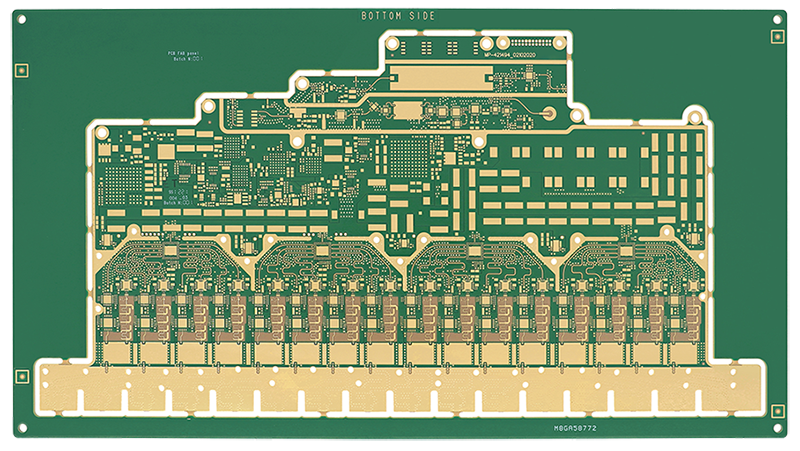
Rogers 4350B Circuit Board PCB Material Datasheet
Rogers4350B is a patented hydrocarbon resin system/ceramic filler material reinforced with woven glass cloth. Its electrical properties are very similar to PTFE/woven glass cloth materials, and its processability is similar to epoxy resin/glass cloth materials.

As the data capacity of 4G and 5G networks continues to increase, microwave radios must utilize a wider bandwidth at higher operating frequencies, typically including 24 GHz, 38 GHz, 42 GHz (Europe), as well as unauthorized frequency bands of 60 GHz and above. Generating and processing these millimeter wave frequency bands is not an easy task. When microwave radio operates at higher frequencies, loss becomes crucial, for example, available power typically decreases with increasing frequency.

The characteristics of Rogers RO4350B high-frequency sheet metal include:
The dielectric constant (Dk: 3.48+/-0.05) of Rogers RO4350B high-frequency sheet has strict tolerance control and low loss characteristics (Df: 0.0037 10GHz), making it easy to mass produce CAF impedance (ion migration resistance). The RO4350B processing technology can be the same as standard epoxy resin/glass cloth.
Rogers RO4350B high-frequency board is fully compatible with traditional PCB manufacturing technology and does not require special pre-treatment for through-hole copper plating (PTFE board requires plasma treatment) or other pre-treatment processes. The solder mask process can also be ground. Compared to traditional microwave material laminates, the price is lower, so they are widely used in active devices and high-power RF designs, requiring a fire rating of UL 94V-0.
Rogers RO4350B high-frequency board material is a proprietary ceramic filling material/hydrocarbon composite material reinforced with textile glass cloth, which combines the electrical properties of PTFE/glass cloth material and the processability of epoxy resin/glass cloth.
The dielectric constant (Dk: 3.48+/-0.05) of Rogers RO4350B high-frequency sheet has strict tolerance control and low loss characteristics (Df: 0.0037 10GHz), making it easy to mass produce CAF impedance (ion migration resistance). The RO4350B processing technology can be the same as standard epoxy resin/glass cloth.
Rogers RO4350B high-frequency board is fully compatible with traditional PCB manufacturing technology and does not require special pre-treatment for through-hole copper plating (PTFE board requires plasma treatment) or other pre-treatment processes. The solder mask process can also be ground. Compared to traditional microwave material laminates, the price is lower, so they are widely used in active devices and high-power RF designs, requiring a fire rating of UL 94V-0.
Rogers RO4350B high-frequency board material is a proprietary ceramic filling material/hydrocarbon composite material reinforced with textile glass cloth, which combines the electrical properties of PTFE/glass cloth material and the processability of epoxy resin/glass cloth.

Rogers RO4350B sheet has the following characteristics:
1. Low RF loss: Df: 0.0037 10GHz;
2. Low dielectric constant: Dk: 3.48+/-0.05 and fluctuates with temperature;
3. Low Z-axis thermal expansion coefficient: 32 ppm/℃;
4. Low internal expansion coefficient of the board;
5. Low dielectric constant tolerance;
6. Excellent dimensional stability;
7. Stable electrical characteristics at different frequencies;
8. The processing technology is similar to FR-4, and it is easy to produce in large quantities and has a significant price competitive advantage due to the multi-layer mixing of FR4;
9. BGABoard's regular inventory Rogers RO4350B high-frequency board material thickness is: 4mil; 6.6mil; 10mil; 13.3mil; 16.6mil; 20mil; 30mil; 60mil.
1. Low RF loss: Df: 0.0037 10GHz;
2. Low dielectric constant: Dk: 3.48+/-0.05 and fluctuates with temperature;
3. Low Z-axis thermal expansion coefficient: 32 ppm/℃;
4. Low internal expansion coefficient of the board;
5. Low dielectric constant tolerance;
6. Excellent dimensional stability;
7. Stable electrical characteristics at different frequencies;
8. The processing technology is similar to FR-4, and it is easy to produce in large quantities and has a significant price competitive advantage due to the multi-layer mixing of FR4;
9. BGABoard's regular inventory Rogers RO4350B high-frequency board material thickness is: 4mil; 6.6mil; 10mil; 13.3mil; 16.6mil; 20mil; 30mil; 60mil.

The Rogers4350BDataSheet material has passed the UL94V-0 fire rating required for active equipment and high-voltage microwave RF board design.
Application field:
Cellular base station antenna and power amplifier
Microwave peer-to-peer connection (P2P)
Automotive radar and sensors
Radio Frequency Identification (RFID) tags
High frequency head (LNB) for live broadcasting satellites
Application field:
Cellular base station antenna and power amplifier
Microwave peer-to-peer connection (P2P)
Automotive radar and sensors
Radio Frequency Identification (RFID) tags
High frequency head (LNB) for live broadcasting satellites
The ER dielectric constant of Rogers high-frequency board (microwave RF board):

As data capacity increases, 4G and 5G wireless communication networks require powerful backhaul links. This type of network not only needs to send a large amount of data between mobile users and base station transceivers, but also needs to send data between different nodes in the network and ultimately send it to the main switching station for access to the backbone internet. Wireless backhaul connections are typically made through fiber optic cables or microwave radios.
When designing components for these high-frequency microwave radios and wireless return devices, designers must understand the losses that affect the strength of radio signals, especially dielectric and conductor losses, from a material perspective. Materials developed for use at frequencies below 40 GHz must be upgraded and optimized to achieve appropriate performance at higher frequencies. E-band microwave radio requires ultra-low loss dielectric materials based on PTFE or advanced thermosetting technology.
Rogers optimized its combination of ultra-low loss circuit materials, using low roughness copper foil to minimize conductor losses and achieve higher frequency usage. Nowadays, microwave radios ranging from 6 GHz to 80 GHz provide a complete backhaul solution through the use of Rogers' low loss materials and low profile copper foil.
When designing components for these high-frequency microwave radios and wireless return devices, designers must understand the losses that affect the strength of radio signals, especially dielectric and conductor losses, from a material perspective. Materials developed for use at frequencies below 40 GHz must be upgraded and optimized to achieve appropriate performance at higher frequencies. E-band microwave radio requires ultra-low loss dielectric materials based on PTFE or advanced thermosetting technology.
Rogers optimized its combination of ultra-low loss circuit materials, using low roughness copper foil to minimize conductor losses and achieve higher frequency usage. Nowadays, microwave radios ranging from 6 GHz to 80 GHz provide a complete backhaul solution through the use of Rogers' low loss materials and low profile copper foil.
What is a Rogers PCB Board ? | PCB Knowledge